A clear comparison across five dimensions — cost, workflow fit, integration, support, and data ownership — to help you choose.
"Should I buy the same accounting software everyone else uses, or have one built for me?" It's a question almost every business owner asks before investing in a financial system. The short answer: it depends on the type of business you run, your transaction volume, and how complex your calculations are. In this article, we offer a genuinely honest, unbiased comparison of both paths.
Off-the-shelf software is designed for a broad range of businesses and typically covers the accounting basics — general ledger, invoicing, simple inventory. Its main advantage is a low upfront cost and fast setup. But that same "one-size-fits-all" design can also be its biggest limitation: if your business has specific needs (like calculating gold labor fees, managing complex sales commissions, or integrating with an online store), you usually have to adapt yourself to the software's constraints, rather than the other way around.
Custom accounting software is built precisely around your real workflow, with no unnecessary constraints. Its main drawback is that it requires more upfront investment and development time compared to buying an off-the-shelf package outright — though that timeline is usually shorter than most people expect.
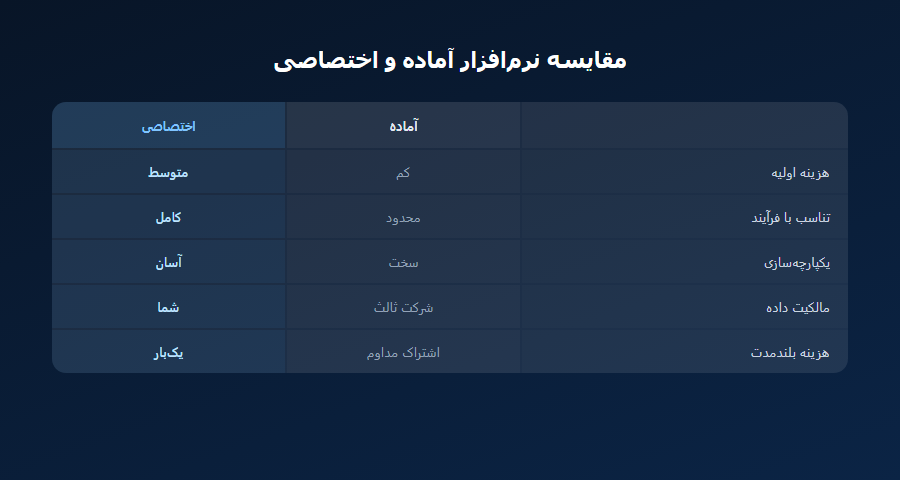
Off-the-shelf software has a lower upfront cost, but it's often priced as a monthly or annual subscription. Custom software costs more upfront but usually carries no ongoing monthly fee, or a much smaller one — over a three-to-five-year horizon, it often comes out ahead financially.
If your business's financial process is standard and straightforward, off-the-shelf software works perfectly well. If your calculations or workflow are specific and different from the norm, custom software is the only option that will genuinely work with precision.
Connecting off-the-shelf software to your online store, point-of-sale system, or warehouse is usually limited, if not impossible. Custom software can be designed from the ground up for full integration with every system your business runs on.
Off-the-shelf software usually comes with generic, non-urgent support. Custom software lets you work directly with the development team and get changes implemented quickly.
With ready-made cloud software, your financial data sits on the provider's server. With a custom build, you have full ownership of your data and the freedom to choose where it's stored.
In a free consultation, our team can review your business's current financial process and give you an honest answer about which path — off-the-shelf or custom — is more cost-effective for you.
 Hamed Rezaie