The real differences between the three main mobile app development paths, and which one truly fits your goal, budget, and timeline.
Before you dive into design details and budgets, one of the most important decisions in building an app comes first: should we build native, hybrid, or is a web app actually enough? This decision directly affects cost, development speed, and the final user experience. In this article, we explain each option simply and practically, so you can make the best choice for your business.
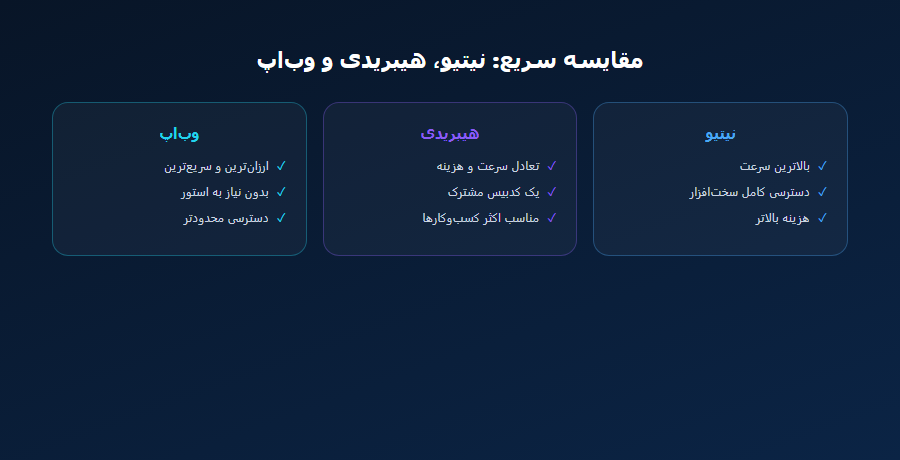
A native app is built directly with each platform's official language and tools — separately for Android and for iOS. This approach delivers the highest execution speed, the best access to phone features (camera, GPS, notifications), and the smoothest user experience. Its main downside is higher development cost and time, since it's essentially two separate projects being built at once.
With the hybrid approach, a single shared codebase is written that runs on both Android and iOS. This significantly reduces development time and cost, and it's fully sufficient and professional for most commercial apps — retail, service-based, or reservation apps. Most users can't tell the performance difference from a native version.
A web app is a website built to behave like an app — it can be installed on your phone's home screen, work offline to some extent, and send notifications, all without needing to be published on any app store. It's the cheapest and fastest route to launch, but it has limited access to the phone's more advanced hardware features.
Your app needs very high performance (like a game or a graphics-heavy tool), or it relies heavily on advanced phone hardware features, and you have the budget to develop two separate versions.
You want to get to market faster, your budget is more limited, and your app is a standard commercial app — retail, reservations, or services — which covers the vast majority of businesses.
You want to build a quick, low-cost test version (an MVP) to validate your idea, or your users mostly interact with you through a browser anyway and you don't need a presence in the app stores.
The right decision depends on your business goal, budget, and timeline — not on which technology sounds "more modern." In a free consultation, our team will look at your project's actual goal and give you an honest answer about which path makes the most sense, even if it's the cheapest option.
 Hamed Rezaie